/https%3A%2F%2Fassets.over-blog.com%2Ft%2Fcedistic%2Fcamera.png)

Speed Training Program. The complete speed training program aims to: Improve acceleration.
Speed Training Practising moving and accelerating faster helps to condition the neuromuscular system to improve the firing patterns of fast twitch muscle fibers. When introducing speed work into a training program, it’s important to do so safely. Running faster will force you to break out of your comfort. Running is a method of terrestrial locomotion allowing humans and other animals to move rapidly on foot. Running is a type of gait characterized by an aerial phase in. Training for the 5k or 10k How to Design the Ultimate Training Plan to Crush Your PR. Despite being short from a distance runner’s standpoint, the 5k and 10k are. Speed Training - Sprint Faster In 14. Training all of the muscles used in the runnning process for faster sprint speed.
Increase maximal velocity. Maintain velocity against the onset of fatigue. Closely related to speed training is agility and quickness training. This aims to: Improve deceleration. Enhance the ability to change direction. Improve co- ordination and dynamic balance.
Speed and agility training are not the same and one does not necessarily improve the other. For example, straight- line sprinting has been shown to have little or no effect on agility tests that involve various changes of direction even though it improves 3. This has obvious implications for many athletes that rarely have to run in straight lines but are involved in regular, quick changes of direction. This article sets out the guidelines for increasing speed and agility. While some components of fitness (such as strength, power and basic speed) are relevant to most athletes, other elements of fitness covered here (such as speed- endurance and agility) are not applicable to all.
Improve your running and jogging abilities with these tips on building strength, stretching, cross-training, increasing speed and perfecting your form.

An obvious example is the 1. The sprinters speed training program will focus predominantly on acceleration and maximal velocity in a straight line, whereas the soccer player rarely, if ever, reaches top speed. He or she will benefit from greater emphasis on agility training. Strength & Power Training. There is a high correlation between an athletes strength and explosive power and their sprint performance (3,4,5). This is usually measured with power tests such as jump squats, reactive jumps and short sprints and strength testing.
Conditioning can significantly increase performance in these tests (6,7,8,9,1. During the early pre- season phase of training, the emphasis is placed on developing maximal strength. The more force a muscle can produce, the more potential there is for greater power and speed. Of course the other element of the power equation is the speed of muscle contraction or the rate of force development. A bodybuilder or weightlifter may be exceptionally strong but lack significant power if they are unable to apply that strength quickly. Similarly, individuals that can contract their muscles and move their limbs very rapidly are not necessarily the fastest athletes as they may not be able to generate significant force with each foot strike.
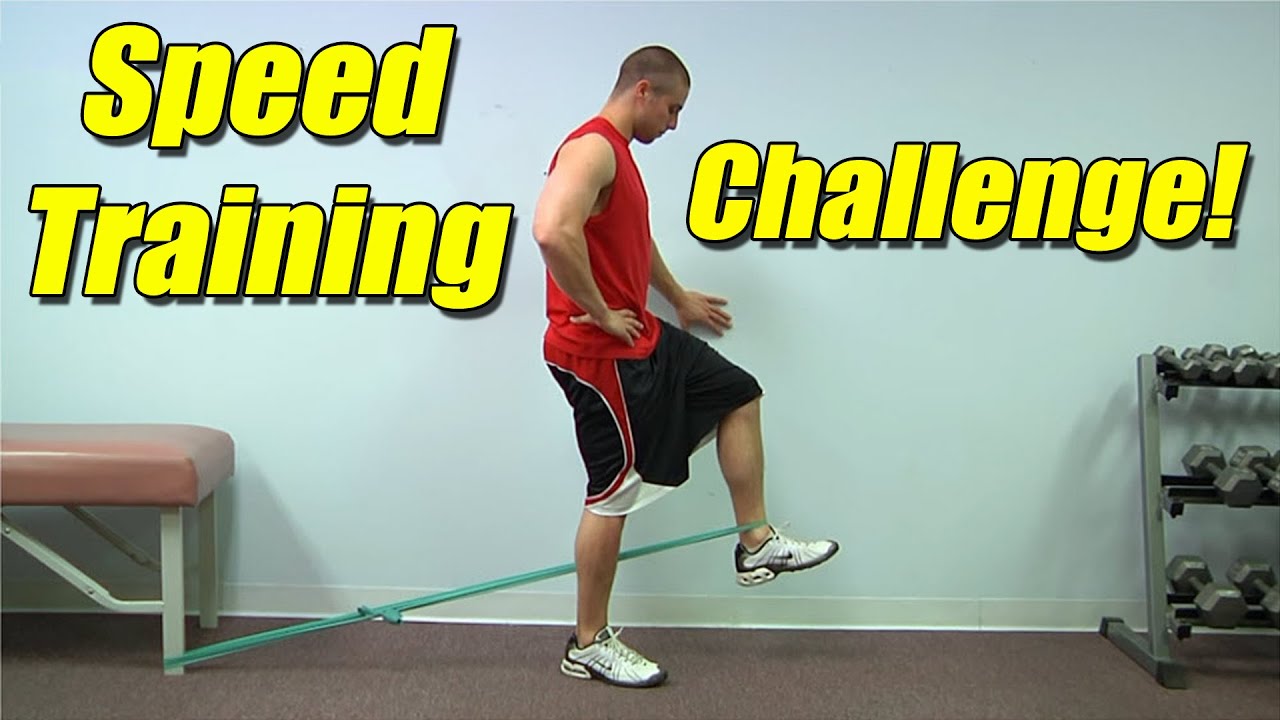
Once a phase of maximal strength training has been completed it can be converted into explosive power through plyometric training for example. For details on a developing a suitable strength and power training program see the sport- specific approach to strength training programs and associated articles. Sprinting Technique. While other elements of the speed training program aim to condition the metabolic and neuromuscular systems, technique training results in a more efficient use of energy. Of course, its not only elite sprint athletes that can benefit from examining and correcting their sprinting technique. Working on running biomechanics is low intensity and should not aim to fatigue the athlete. It should be completed before strenuous training and can even form the back- end of the warm up.
Click here for more details on sprinting technique. Basic Speed Training. While strength and power training alone can increase an athletes speed, combining it with sprint training is more effective (2).
Basic sprints help to improve reaction time, acceleration, top speed and deceleration. Keeping the exercise intervals short (i.
Sprints can be repeated at near maximal velocity, which is necessary to induce the right neuromuscular adaptations. A basic speed training program can be adapted by running uphill and downhill. Incline running helps to improve power during hip flexion and extension (1. Downhill running is effective at improving co- ordination and stride frequency (1.
Click here for some sample speed training program drills. Agility Training.
Liner speed training aims to improve speed and acceleration and requires maximal effort and near maximal velocity. This is best achieved when running in a straight line. However, most team sports require rapid declaration and changes in direction. Agility training aims to convert basic speed into sport- specific speed. As with basic sprint training, the work to rest ratio should allow adequate recovery between intervals and sets. Agility training relies on a high degree of co- ordination and movement quality, which becomes difficult in the presence of fatigue. Many of the coaching points for proper sprinting technique can be applied to agility training.
Sprint technique, basic speed training and agility training should all occur at the start of a training session when the athlete is fresh. A 2. 0minute period is enough to combine basic sprints, technique practise and agility drills or they can be split up over several training days.
Click here for some sample agility exercises. Speed Endurance Training.
A fast athlete can not only accelerate and move in multiple directions rapidly, they should also have the ability to repeat rapid movements with minimal loss of speed. In multi- sprint sports such as hockey and basketball, players are often required to repeat several high intensity runs, all- out sprints and sharp changes in direction without rest. This type of activity leads to rapid blood lactate accumulation severely hindering peak power and rate of force development (1.
Training can help to curb lactate accumulation and increase the rate of clearance (1. For many athletes, the introduction of one or two speed endurance sessions during the latter stages of pre- season training is an important component of the overall speed training program. A speed endurance session is created by reducing the work to rest ratio (i.
Unlike basic speed and agility training, speed endurance conditioning is highly fatiguing and energy depleting. For this reason it may be more appropriate for skill and tactical work to occur beforehand in the training session. Click here for some sample speed endurance drills. Periodization of a Speed Training Program. As with other components of conditioning, the speed training program varies over the course of the year.
How much emphasis it is given at any point in the season obviously depends on the sport (i. For team sports the following model is an example of how speed training changes over the course of a competitive year: Early Pre- Season. The emphasis is on building a general conditioning base with maximal strength training and endurance training. Little or no sprint work is completed at this time. Sprinting technique can be addressed here if it is a particular concern for the athlete.
Because it is non- fatiguing and low intensity it wont interfere with other forms of training during this phase. Late Pre- Season.
Strength is converted into explosive power with plyometric training or ballistics for example. Basic speed training and agility training is now incorporated into the overall program. It can take up to 8 weeks for before a conditioning response is seen (1. In- Season. Speed and agility training is maintained. This can be achieved in 1- 2 sessions per week at the start of a longer, mixed training session. Transition / Closed Season.
This phase is used for active recovery and regeneration. All speed training can be ceased and muscle balance issues addressed.
Click here for a sample closed season training plan.


/https%3A%2F%2Fassets.over-blog.com%2Ft%2Fcedistic%2Fcamera.png)